


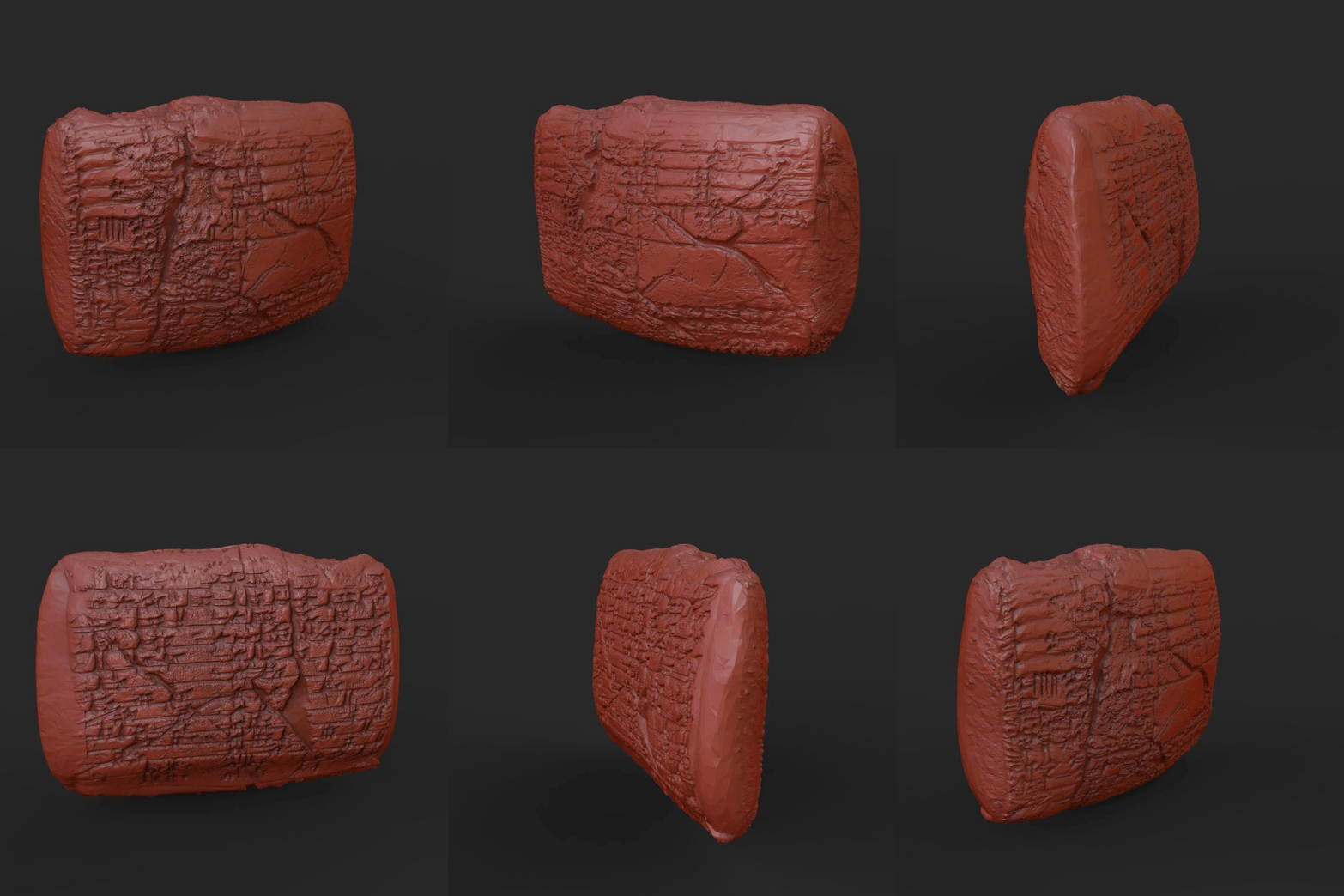
The digital preservation of ancient artifacts allows us to bridge millennia, bringing rare historical documents into sharper focus than ever before. This is a high-detail 3D model of a truly unique cuneiform artifact: CUNES 50-11-020.
First brought to scholarly attention by Andrew George and Manfred Krebernik in their landmark study “Two Remarkable Vocabularies: Amorite-Bilinguals!”, this Old Babylonian tablet—along with its counterpart—provides unprecedented direct insight into a language that was rarely committed to writing in antiquity: Amorite.
A Window into the Amorite Language
Dated to the early second millennium BCE (Old Babylonian period), CUNES 50-11-020 is structured as a two-column bilingual list. While the right-hand column records standard Old Babylonian Akkadian, the left-hand column captures a North-West Semitic vernacular. Through rigorous linguistic analysis, researchers have identified this left-hand column as a priceless lexicon of the Amorite language.
What makes this tablet extraordinary for enthusiasts of historical linguistics and ancient scripts is how the vocabulary preserved on the clay mirrors linguistic features later found across the broader Semitic family—most notably in Hebrew and Arabic.
Remarkable Parallels with Hebrew and Arabic
A close examination of the terms inscribed on the left-hand column reveals striking etymological and grammatical connections that bridge ancient Mesopotamia with the linguistic landscapes of the Levant and Arabia:
- Lexical Shared Roots:
- The word for “bread” (la-ah-mu / lahmu) directly corresponds to Hebrew lāḥām (leḥem) לֶחֶם and Arabic laḥm لَحْم (though shifting slightly in semantic specialization over time).
- The term for “wine” (ia-a-a-nam / yaynam) matches Hebrew yayin יַיִן.
- Water me-e Hebrew Mayim (מַיִם)
- Sacrifice za-ba-a-ḫa Hebrew Zevaḫ (זֶבַח) Arabic ذَبَحَ (dabāha)
- First Fruits bi-ik-ra-ti-ia Hebrew Bikkurim / Bikkurot (בִּכּוּרִים)
- Turban/Scarf ṣi-ni-ip-tum Hebrew Tzanif (צָנִיף)
- Moon / month ŝahr Arabic ŝahar شَهْر: While Biblical Hebrew does not use śahr as its base word for “month,” it preserves the exact same root phonology in the noun שַׂהֲרֹנִים (saharonim), which translates to ” crescents” or “little moons / crescent-shaped ornaments” (found in Judges 8:21, 26 and Isaiah 3:18).
- Pleiades kēmat Hebrew Kimah (כִּימָה)
- Terms relating to social life and anatomy, such as the word for “friend” (ra-ha-a-a / rafay-ya) arabic رَفَ… (raf-) and “foot/thigh” (pa-ah-ma-a / pasmay), display classic West Semitic root correspondences.
- 2. Full Conversational Phrases
- The most striking element of the George & Krebernik tablets is that they preserve complete spoken sentences. The syntax (word order) and vocabulary mirror Hebrew directly:
- Amorite:ti-nam me-e la-a-i-de-ni
- Hebrew translation: Ten mayim al yadeinu (תּן מַיִם עַל יָדֵינוּ)
- English: “Give water onto our hands.”
- Amorite:ia-a-a-nam si-qí-ni-a-ti
- Hebrew translation: Yeinam shikitani / Hashqeinu yayin (הַשְׁקֵנוּ יַיִן)
- English: “Pour us wine.” / “Give us wine to drink.”
-
- Amorite:si-ḫa šu-ul-ḫa-nam
- Hebrew translation: Se’ah et ha-shulchan / Havei et ha-shulchan (הָבֵא אֶת הַשֻּׁלְחָן)
- English: “Fetch/bring the table.”
- Amorite:la-aḫ-ma-am bi-lam na-a-NAM
- Hebrew translation: Havei lechem eleinu (הָבֵא לֶחֶם אֵלֵינוּ)
- English: “Bring us bread.”
- 3. Grammatical Similarities
- Beyond shared words, the fundamental mechanics of the Amorite language look distinctly Canaanite rather than Mesopotamian:
- The Suffix Pronoun -nu: To say “our hands,” Amorite used the trailing suffix -ni/-nu, just like the Hebrew suffix -nu (יָדֵינוּ – yadeinu).
- The Imperative Form Ti-nam: The Amorite word for “give” utilizes the root n-t-n (to give). Dropping the initial “n” in the imperative command form (Tên / Ten) is a distinct grammatical quirk shared by both Amorite and Hebrew.
- The Verb “To Live” (ḫ-w-y): The tablets show the formula liḥwī-ka (“May God keep you alive”). This stems from the West Semitic root ḫ-w-y (to live / to be), which is the direct archaic variant of the Hebrew root ḫ-y-y (חיה) and figures prominently in early Hebrew names like Ḥavah (Eve/Life).
- Amorite:si-ḫa šu-ul-ḫa-nam
From Cuneiform Clay to Digital 3D Replicas
Transforming such complex archaeological data into precise 3D assets requires balancing strict metrological accuracy with digital mesh optimization. Reconstructing CUNES 50-11-020 digitally allows students, researchers, and history enthusiasts to inspect the cursive Old Babylonian ductus, the vertical rulings, and the unique edge inscriptions from every angle—offering an interactive tactile experience of a text that reshaped our understanding of second-millennium BCE linguistics.
By merging modern 3D modeling with epigraphic scholarship, we continue to preserve and celebrate the rich, interconnected heritage of the ancient Near East. .
