
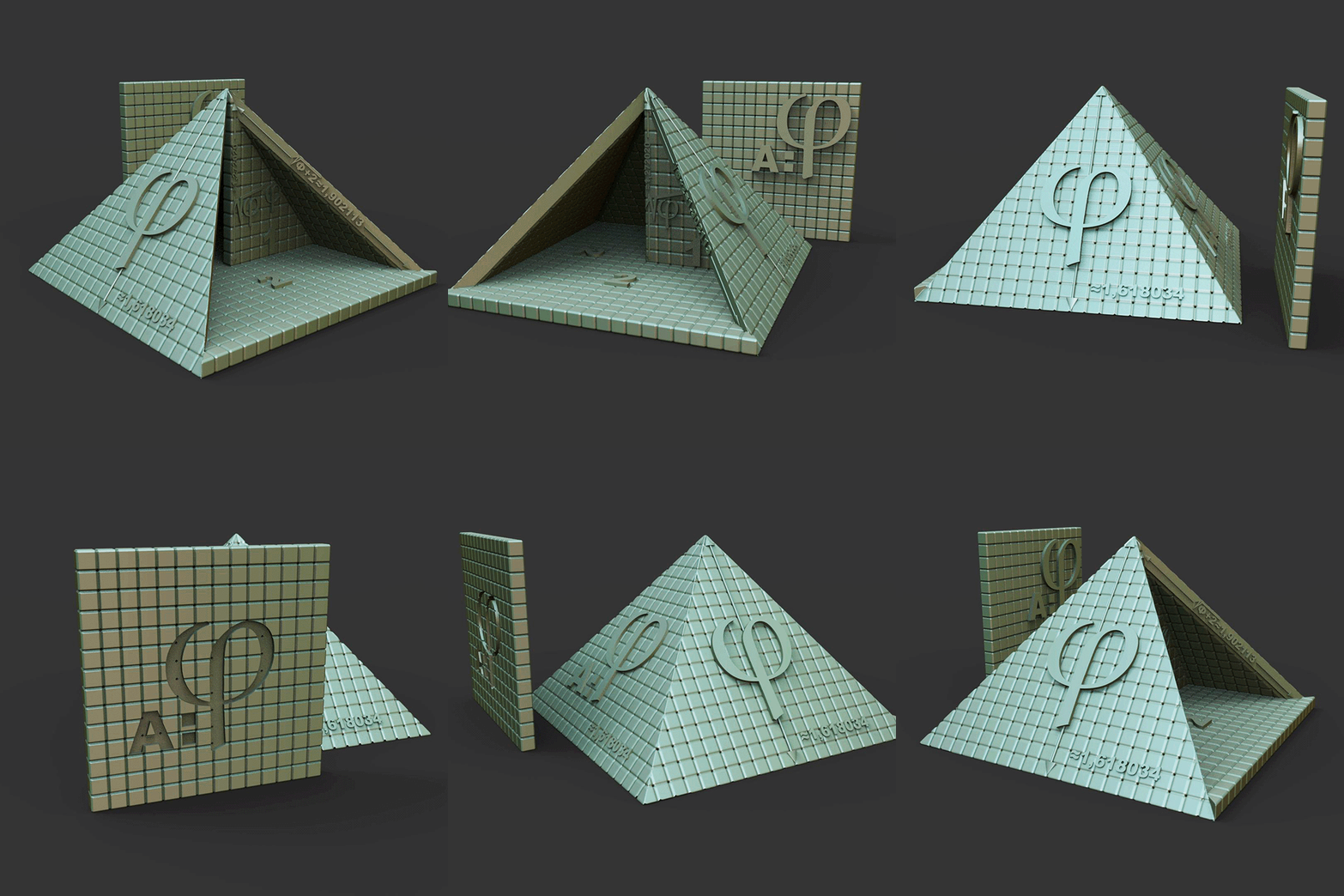

Download 3D Model
A Mathematical Correspondence Between the Kepler Triangle and the Great Pyramid of Giza

In 1597, Johannes Kepler described a particularly harmonious right triangle whose sides form a geometric progression. Their lengths are proportional to
where the golden ratio and:
.
The triangle brings together a right angle, a geometric progression, and the golden ratio in one simple figure.
The Phi – ramid
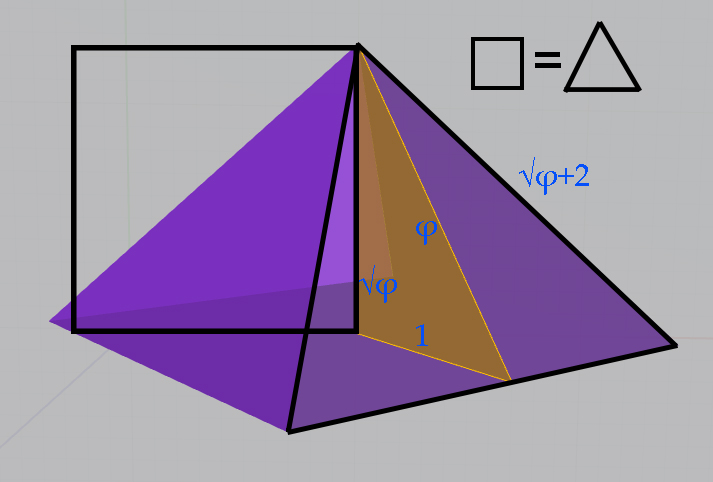
Consider a regular square-based pyramid in which the square of the pyramid’s height is equal to the area of each triangular face. This condition leads naturally to the proportions of a Kepler triangle. We can call this construction a Phi-ramid.
The correspondence is therefore as follows:
- The half-side of the pyramid’s base corresponds to 1.
- The pyramid’s height corresponds to √Φ.
- The slant height of a triangular face corresponds to Φ.
This creates a striking mathematical relationship between the two-dimensional geometry of the Kepler triangle and the three-dimensional geometry of a regular square-based pyramid.
Comparison with the Great Pyramid
For the Great Pyramid of Giza, the traditional dimensions are often approximated as 440 royal cubits for each side of the base and 280 royal cubits for the original height. The half-side of the base is therefore 220 cubits, giving:
Half-side of base / height = 220 / 280 = 11 / 14
Equivalently:
Height / half-side of base = 14 / 11 ≈ 1.2727
This is remarkably close to:
√Φ ≈ 1.2720
The simple integer proportion 11:14 therefore provides a practical approximation to the exact Kepler-triangle relation.
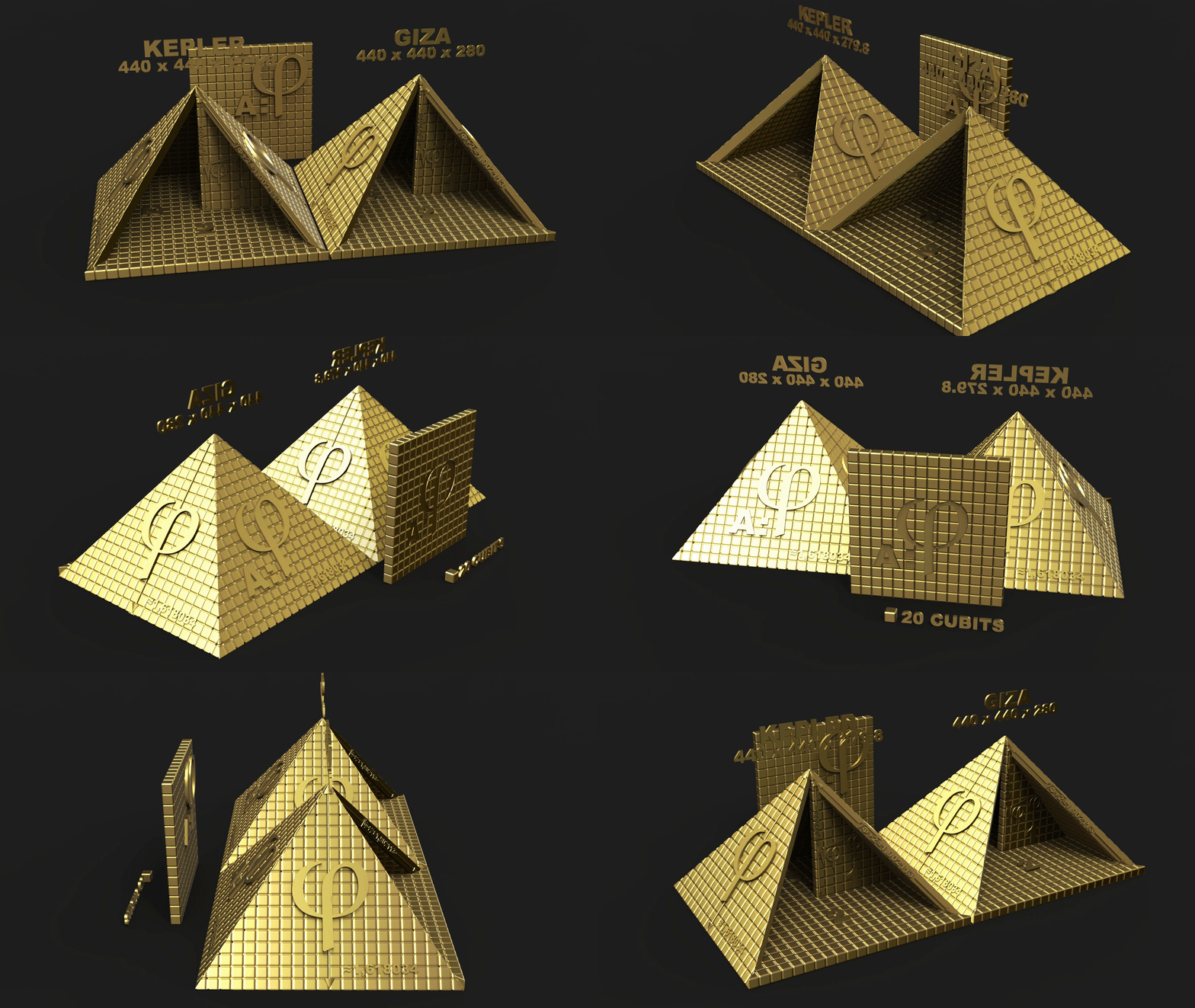
The comparison can be summarized as:
Kepler triangle: 1 : √Φ : Φ
Great Pyramid profile: 11 : 14 : approximately 18
The difference between the idealized Kepler Phi-ramid and the traditional proportions of the Great Pyramid is extremely small and would be essentially invisible to the naked eye in a physical model.
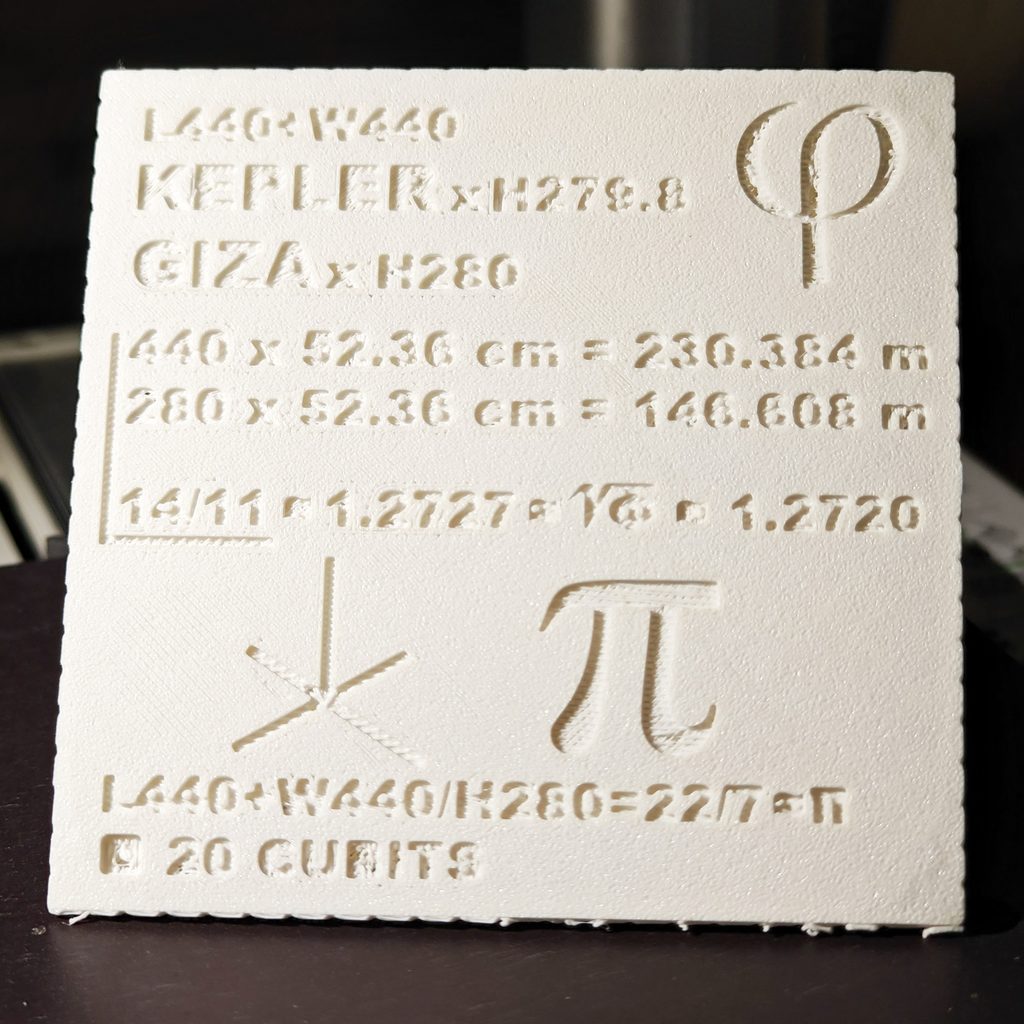
The PI- RAMID connection with π
The pyramid’s proportion also creates a close approximation to . If the half-side of the square base is , the full side is , so the perimeter is:
P=4×22=88.
With a height of , twice the height is:
2H=28.
Therefore:
2HP=2888=722≈3.142857.
This is very close to:
π≈3.141593.
Equivalently:
HP=744≈2π.
